How to Train a Puppy to Ring a Bell to Go Outside
Teach your puppy to communicate potty needs clearly with a simple bell — a step-by-step training guide that reduces accidents and builds trust.
Few things frustrate new puppy owners more than accidents in the house. You take your puppy outside, they sniff around, and then the moment you bring them back in, they squat on the rug. The problem is rarely that your puppy doesn't understand where to potty — it's that they have no way to tell you they need to go. Bell training solves that communication gap.
When you train a puppy to ask to go outside with a bell, you give them a clear, consistent signal that both of you understand. This guide walks you through the entire process, from choosing the right bell to troubleshooting the most common problems, so you can stop guessing and start building a reliable potty routine.
Why Bell Training Works
Dogs are naturally communicative animals, but they don't speak our language. A puppy who needs to potty may pace, whine, scratch at the door, or simply stand by the exit — signals that are easy to miss, especially when you're busy. A bell gives your puppy a consistent, unmissable way to get your attention.
Bell training works because it combines three powerful training principles:
- Clear communication: The bell is an unmistakable sound. You won't miss it the way you might miss a subtle whine or a puppy standing quietly by the door.
- Positive reinforcement: Every time your puppy rings the bell and you respond by taking them out, the behavior is reinforced. The puppy learns that ringing the bell produces a real result.
- Consistency: The same signal every time creates a reliable habit. Unlike scratching or whining, which are easy to ignore or misinterpret, the bell is always the same cue for the same outcome.
Bell training is especially useful for puppies who are already on a structured potty schedule but still have accidents because they don't know how to signal in between scheduled breaks. It's a bridge between your routine and their growing ability to communicate needs. For more foundational strategies, see our guide on training a puppy to tell you they need to go outside.
Important context: Bell training is not a replacement for a proper potty schedule. Young puppies under 16 weeks cannot hold their bladders for long, so you must still take them out frequently. The bell simply gives them a way to tell you when they need to go between scheduled outings.
Choosing the Right Bell
The best bell is one your puppy can physically reach and ring without effort. Here's what to look for:
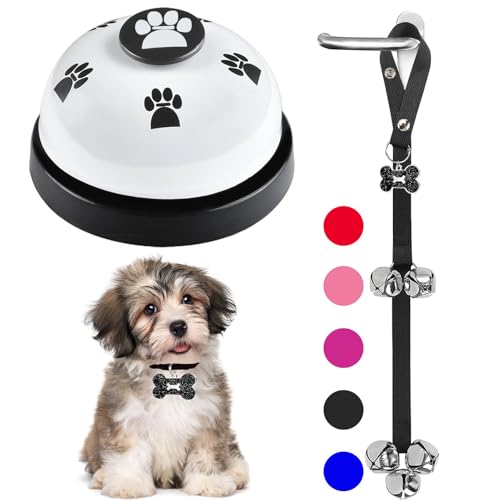
- Hanging sleigh bells: A strap of 2-5 bells that hangs from the door handle. These are the most popular choice because they're loud enough to hear from another room and easy for a puppy to nose or paw.
- Wireless doorbell button: A button placed on the floor near the door that triggers a chime inside the house. Great for owners with mobility issues or for dogs who have trouble reaching hanging bells.
- Single large bell: A bell attached to a short strap or rope. Simple and effective, but make sure it's loud enough to hear from anywhere in your home.
- Mounting height: The bell should hang at your puppy's nose height. They should be able to touch it without jumping. As your puppy grows, adjust the length so it stays reachable.
Tip: Avoid loud, heavy bells that might scare a very young or timid puppy. If your puppy seems startled by the sound, try a softer bell or a wireless doorbell with a gentle chime. The goal is to make the bell a positive, familiar tool, not something to fear.
Once you've chosen your bell, hang it on the door you'll use most often for potty breaks. Consistency matters — use the same door and the same bell for every potty outing during training. If you have multiple doors, you can add a bell to each, but start with one to keep the learning simple.
Preparing for Training
Before you start bell training, make sure you have these basics in place:
- A consistent potty schedule: Take your puppy out at the same times every day — first thing in the morning, after meals, after naps, after play, and before bed. A puppy who is already used to going outside on a schedule will understand the purpose of the bell more quickly.
- A designated potty area: Choose a specific spot in your yard where you always take your puppy. This helps them associate the location with the behavior.
- High-value treats: Use small, soft treats your puppy loves. These will be used to reward interaction with the bell and successful potty breaks.
- A leash for potty breaks: During bell training, take your puppy out on a leash so you can guide them directly to the potty area and prevent them from wandering off to play.
- Patience and consistency: Bell training usually takes 1-3 weeks of daily repetition. Every adult in the household must use the bell consistently, or your puppy will get confused.
If your puppy hasn't yet mastered basic potty training, it's worth reviewing our guide on potty training a puppy to ask to go outside before layering on the bell. The bell is a communication tool, not a standalone training method.
Step-by-Step Training Process
Bell training happens in phases. The first phase teaches your puppy to touch and ring the bell. The second phase teaches them to use the bell purposefully to request a potty break.
Phase 1: Introduce the Bell
- Let your puppy investigate: Allow your puppy to sniff and explore the bell without pressure. Don't force it — let them become familiar with the new object.
- Reward any interaction: When your puppy noses, paws, or even bumps the bell, immediately praise them and give a treat. The goal at this stage is to create a positive association with the bell and encourage the puppy to interact with it.
- Hold a treat near the bell: Hold a treat slightly behind the bell so your puppy has to touch the bell to reach the treat. The moment they touch it, the bell rings and they get the treat. Repeat this several times per session.
- Add a verbal cue: Say "ring the bell" or "touch" just before your puppy touches the bell. With repetition, they'll start to associate the words with the action.
Phase 2: Connect the Bell to Going Outside
- Ring the bell yourself before every potty break: At first, you'll ring the bell, not your puppy. Before you take your puppy out, gently ring the bell, say "potty" or "outside," and immediately open the door. This teaches the puppy that the bell sound predicts going outside.
- Guide your puppy to ring the bell: As you go to take your puppy out, gently hold a treat near the bell and encourage them to touch it. The moment they ring it, open the door and go out.
- Take them straight to the potty area: Once outside, go directly to the designated potty spot on the leash. Give your puppy 5-10 minutes to eliminate. Don't play or wander — the goal is to reinforce that ringing the bell leads to a potty break, not a walk.
- Reward successful potty breaks: If your puppy eliminates outside, praise enthusiastically and give a high-value treat immediately. This reinforces the entire chain: ringing the bell, going outside, and doing the right thing.
- If they don't go, go back inside: If your puppy doesn't eliminate after 5-10 minutes, calmly bring them back inside. If they ring the bell again, take them out again. Repeat this patiently. Never let your puppy stay outside to play after an unsuccessful potty break, or they'll learn that the bell means playtime.
Consistency checkpoint: Every single time you take your puppy out to potty during the training period, ring the bell first. If one family member rings the bell and another just opens the door, your puppy will be confused about what the bell means. Make sure everyone follows the same routine.
Pairing the Bell with Your Potty Schedule
The bell works best when it's embedded in a consistent potty schedule. Here's a daily routine that supports bell training:
| Time | Action | Bell Training Step |
|---|---|---|
| Early morning | First potty break | Ring bell, say "potty," take puppy out on leash |
| After breakfast | Potty break | Ring bell, take puppy directly to potty area |
| Mid-morning | Potty break (young puppies) | Guide puppy's nose to bell, open door when it rings |
| After play/nap | Potty break | Prompt puppy to ring bell before opening door |
| Afternoon | Potty break | Encourage independent bell ringing, reward success |
| Evening | Potty break | Same routine — consistency is key |
| Before bed | Final potty break | Ring bell, short potty break, then bedtime |
As your puppy starts to ring the bell on their own between scheduled breaks, praise and take them out immediately. Even if it's an inconvenient time, respond. Ignoring a bell ring during training teaches your puppy that the bell doesn't always work, and the behavior will fade.
For more in-depth guidance on establishing a potty routine, see our article on teaching a puppy not to poop in the house and our tips on puppy-proofing your home to reduce accidents.
Common Bell Training Mistakes to Avoid
Bell training is simple, but there are a few common traps that can slow progress or create unwanted behaviors:
- Turning potty breaks into playtime: If you let your puppy out to play every time they ring the bell, they'll learn that the bell means "let's go play" rather than "I need to potty." Always take them straight to the potty area on a leash, and only reward the bell with a potty break.
- Not responding to the bell consistently: If you ignore the bell when you're busy, your puppy learns that ringing doesn't always work. During training, respond every single time, even if you're in the middle of something.
- Punishing accidents after the fact: If your puppy potties in the house because they didn't ring the bell, don't punish them. Clean it up without fuss and commit to more consistent bell training. Punishment makes puppies hide accidents, not understand the bell.
- Inconsistent bell usage by family members: If one person rings the bell and another doesn't, your puppy can't learn what the bell means. Make sure every adult in the household follows the same routine.
- Using the bell without a potty schedule: The bell is a communication tool, not a replacement for a schedule. Young puppies can't hold their bladders for long, so you must still take them out frequently regardless of whether they ring the bell.
- Hanging the bell too high: If your puppy can't reach the bell, they can't ring it. Check the height regularly as your puppy grows.
Troubleshooting Bell Training Problems
My Puppy Rings the Bell Just to Go Out and Play
This is the most common issue. The fix is to make the bell predict a potty break and nothing else. When your puppy rings, take them out on a leash, go straight to the potty spot, and give them 5-10 minutes. If they potty, reward and return inside. If they don't, bring them back in without play. If they ring again right away, take them out again, but keep the routine strictly potty-focused. Most puppies stop "false alarms" within a week or two once they learn the bell doesn't produce a play session.
My Puppy Is Afraid of the Bell Sound
Some puppies are startled by loud bells. Try a softer bell, a wireless doorbell with a gentle chime, or cover the bell with a cloth to muffle the sound while your puppy gets used to it. Start by just letting them sniff the bell and feeding treats near it without ringing. Gradually increase the volume and frequency of ringing while pairing it with treats. Never force a scared puppy to interact with the bell — patience will get you further than pressure.
My Puppy Never Rings the Bell on Their Own
If your puppy is not ringing the bell independently after 2-3 weeks, go back to the physical prompt phase. Gently guide their nose toward the bell every time you take them out, and reward heavily when they touch it. Make sure the bell is positioned where they can reach it easily. It's also worth checking whether your puppy is motivated by the reward — if treats aren't exciting, try a favorite toy or more enthusiastic praise. Some puppies simply need more repetitions than others, and there's no race to the finish line.
Patience tip: Some puppies learn bell training in a few days; others take a month. The timeline depends on breed, age, previous potty training, and consistency. If you feel stuck, check whether everyone in the household is following the same routine. Inconsistency is the most common cause of slow progress.
Phasing Out the Bell (Optional)
Some owners keep the bell permanently as a communication tool, while others phase it out once their puppy is fully potty trained and can ask to go out in other ways. If you want to phase out the bell:
- Wait until potty training is solid: Your puppy should be consistently going to the door and asking to go out in other ways before you remove the bell. This usually happens around 6-12 months of age, depending on the breed and individual puppy.
- Gradually reduce bell use: Stop prompting the bell during scheduled potty breaks. Continue to respond if your puppy rings it, but don't encourage it as actively.
- Add an alternative signal: Teach your puppy to sit by the door or touch a door handle as an alternative way to ask to go out. Reward that behavior consistently.
- Remove the bell when ready: Once your puppy is reliably signaling in other ways, you can remove the bell. If accidents increase, temporarily reintroduce it and go back to the earlier training steps.
For more advanced training techniques, including how to handle separation-related behaviors, see our resources on stopping puppy whining at night and kennel training a puppy with separation anxiety.
Frequently Asked Questions
You've Got This
Bell training is one of the simplest and most effective communication tools you can teach your puppy. It reduces accidents, builds trust, and gives your puppy a way to tell you what they need. Start with a consistent potty schedule, reward every interaction with the bell, and respond every time your puppy rings. Within a few weeks, you'll wonder how you ever managed without it. If you're bringing home a new puppy, our puppy-proofing guide and puppy communication guide will help you set up a smooth routine from day one.