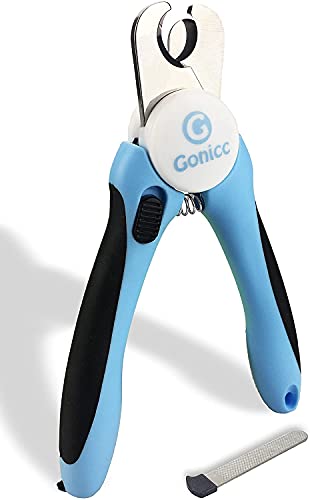
Professional Dog Nail Clippers for Thick Nails
Heavy-duty clippers that cut through dense, tough nails cleanly and safely — without crushing, splintering, or traumatizing your dog.
If you own a large breed, a senior dog, or any dog whose nails have grown dense and hard over time, you already know the frustration: regular clippers simply don't cut it. They crush instead of slice, require two hands and a lot of force, and leave jagged edges that snag on carpet and scratch floors. Worse, the struggle stresses your dog and makes every future trim harder.
Professional-grade clippers designed specifically for thick nails solve this problem. They have the leverage, blade geometry, and build quality to make clean cuts with minimal pressure — which means less discomfort for your dog and less anxiety for you. This guide explains exactly what makes a clipper suitable for thick nails, which styles work best, and how to use them safely at home.
Why Thick Nails Need Specialized Clippers
Dog nails are made of keratin — the same protein as human fingernails — but they are considerably denser. In large breeds, working dogs, and dogs whose nails don't wear down naturally on pavement, the nail wall becomes thick and hard. A clipper that works fine on a Chihuahua's thin nails may fail completely on a Rottweiler's dense, curved nails.
When a clipper lacks the strength for the job, several problems occur. The blade crushes the nail rather than slicing through it, which is painful and can cause the nail to split vertically — sometimes all the way to the quick. The extra force required also makes it harder to control the cut, increasing the risk of cutting too close. And the whole ordeal takes longer, which gives your dog more time to become anxious and resistant.
Signs Your Current Clippers Aren't Up to the Task:
• You need to squeeze with both hands to make a cut.
• The nail crunches or splinters instead of producing a clean slice.
• The clipper twists or flexes under pressure.
• The cut edge looks ragged or white and powdery.
If any of these sound familiar, your clippers are undersized or dull for your dog's nail thickness. Continuing to use them risks injury and makes nail trimming an unpleasant experience for both of you.
It's also worth noting that thick nails are not solely a large-breed issue. Senior dogs often develop thicker, harder nails as their growth cycle changes. Dogs with certain metabolic conditions may also produce denser keratin. And black nails, regardless of dog size, hide the quick and demand more precision — which sharp, well-made clippers provide.
Clipper Types for Thick Nails
Not all clipper designs are equal when it comes to thick nails. Here's how the main styles compare for dense, tough nails.
Plier-Style Clippers
The professional standard for thick nails. Plier-style clippers use a heavy-duty spring and compound leverage to multiply your hand strength, producing clean cuts through dense keratin with minimal effort. The blades are typically replaceable and made from hardened stainless steel.
Recommended for thick nailsScissor-Style Clippers
Similar to pliers but with a scissor-like handle configuration. Good for thick nails when built with quality steel and a sturdy pivot. However, lower-end scissor clippers often flex under pressure. Look for models described as heavy-duty or professional-grade.
Suitable if heavy-dutyGuillotine Clippers
A single blade rises through a loop to cut the nail. While easy to position, guillotine clippers are not recommended for thick nails — the design lacks the strength to cut through dense keratin without crushing, and the blade can dull quickly on hard nails.
Not ideal for thick nailsNail Grinders
Rotary tools that file the nail down gradually. Grinders work well on thick nails because they remove material slowly without crushing, and they eliminate the risk of a sudden cut into the quick. However, they require desensitization to noise and vibration, and they take longer than clipping.
Alternative for anxious dogsFor most owners of thick-nailed dogs, a quality plier-style clipper is the most practical choice. It combines speed, control, and cutting power. If your dog is severely noise-sensitive or you struggle with the "snap" sensation, a grinder used alongside clippers for finishing is a good hybrid approach.
Key Features to Look For
When shopping for professional dog nail clippers for thick nails, these are the features that separate tools that work from tools that frustrate.
- Hardened stainless steel blades: Cheap steel dulls quickly on thick nails. Look for blades described as hardened, high-carbon, or German stainless steel. Sharpness is not a luxury here — a dull blade crushes the nail and hurts your dog.
- Heavy-duty spring mechanism: The spring is what reopens the clipper after each cut. On thick nails, a weak spring forces you to wrestle the tool open between snips. A strong spring makes the process smooth and reduces hand fatigue.
- Compound leverage or reinforced pivot: This is the engineering that lets you cut through dense keratin without excessive force. Quality clippers are designed so the blade meets the nail with power, not just pressure.
- Ergonomic, non-slip handles: Thick nails require control. Smooth plastic handles become slippery when your hands sweat or your dog wiggles. Rubberized or textured grips give you a secure hold.
- Safety lock: A locking mechanism keeps the blades closed when not in use. This protects the blade edge from damage and prevents accidental cuts when the clipper is stored in a drawer.
- Replaceable blades: Professional-grade clippers often allow blade replacement. This extends the life of the tool and ensures you always have a sharp edge for thick nails.
About Safety Guards: Many clippers include a guard designed to prevent over-cutting. For thick nails, these guards can actually be counterproductive. They obscure your view of the nail and the quick, and they limit how much nail you can remove per cut — which means more cuts, more time, and more stress. Experienced owners of thick-nailed dogs often remove or ignore the guard and rely instead on small, frequent cuts and good lighting. If you're new to trimming, a guard can provide peace of mind, but learn to trim without it as your confidence grows.
Clipper Type Comparison for Thick Nails
| Feature | Plier-Style | Scissor-Style | Guillotine | Grinder |
|---|---|---|---|---|
| Cutting Power | Excellent | Good (if heavy-duty) | Poor | N/A (files) |
| Control & Precision | Excellent | Good | Moderate | Excellent |
| Speed | Fast | Fast | Moderate | Slow |
| Best For | Large breeds, dense nails, professional use | Medium-large nails, owners who prefer scissor grip | Small to medium dogs with thin nails | Anxious dogs, finishing edges, very thick black nails |
| Learning Curve | Low | Low | Moderate | Moderate |
| Risk of Crushing | Very low (with sharp blade) | Low | High | None |
The takeaway is clear: for thick nails, plier-style clippers offer the best combination of cutting power, speed, and control. Scissor-style clippers can work if they are genuinely heavy-duty, but many consumer models are not built for dense keratin. Guillotine clippers should be avoided for thick nails. Grinders are a valuable supplement or alternative but are not a direct replacement for the speed and simplicity of a good pair of clippers.
Safe Trimming Technique for Thick Nails
Even the best clippers require proper technique. Thick nails demand patience and a methodical approach, especially if your dog has dark nails or a long quick.
- Prepare your dog and your space. Choose a quiet time when your dog is calm, ideally after a walk. Use a non-slip surface like a rubber mat or yoga mat. Have styptic powder and treats within reach. If your dog is nervous, enlist a helper to offer treats and gentle restraint.
- Examine the nail before cutting. For light nails, you can see the pink quick inside. For dark nails, hold the paw up to good light and look at the underside — the quick appears as a lighter, fleshy area. Your goal is to cut several millimeters in front of the quick, never into it.
- Take small cuts. This is especially important for thick nails. Take thin slivers off the tip rather than attempting to remove the entire overgrowth in one cut. After each cut, inspect the cut surface. A chalky white center means you have room; a dark spot or moist appearance means the quick is close — stop.
- Cut at a slight angle. Angling the cut so it follows the natural curve of the nail produces a cleaner edge and reduces the chance of splitting. Avoid cutting straight across, which can create a blunt edge that clicks on floors.
- Check the dewclaws. These are the nails on the inner side of the leg, higher up. They don't contact the ground and therefore grow unchecked. They can curl into the paw pad if neglected. Trim them with the same care as the other nails.
- Reward generously and frequently. Give treats after each nail, or after each paw if your dog is comfortable. This builds a positive association and makes future trims easier. If your dog becomes stressed, stop and try again another day — forcing the issue creates lasting fear.
If You Cut the Quick: It happens even to experienced owners. Stay calm. Apply styptic powder (or cornstarch or flour in a pinch) to the nail tip with gentle pressure. The bleeding typically stops within a few minutes. If it doesn't stop after 15-20 minutes of pressure, contact your vet. Do not punish your dog or show frustration — the accident was yours, not theirs.
Common Mistakes to Avoid
- Using dull blades on thick nails. A dull blade on a thick nail is dangerous. It requires more force, increases the risk of crushing or twisting, and makes the cut jagged. If your clipper crushes rather than slices, replace the blade or the clipper.
- Buying clippers sized for small dogs. Size ratings matter. A clipper designed for small breeds may physically fit around a large nail, but the blade and mechanism are not built for the density. Use a clipper rated for your dog's weight range.
- Cutting too much at once. Thick nails often have long quicks, especially if they haven't been trimmed regularly. Trying to restore a short nail in one session is a recipe for cutting the quick. Take small amounts over several sessions, spaced a week apart, to let the quick recede.
- Skipping the reward. Nail trimming is not inherently enjoyable for most dogs. If the only outcome of a trim is discomfort and restraint, your dog will resist harder each time. High-value treats during and after the session change the emotional association.
- Ignoring stress signals. Lip licking, yawning, pulling away, and freezing are early signs of stress. If you push through these signals, your dog may escalate to growling or snapping — not because they are "bad," but because they are afraid and have no other way to communicate. Stop and try again later.
Frequently Asked Questions
The Bottom Line
Thick nails are not a problem to be endured — they are a tool-matching issue. A professional-grade plier-style clipper with sharp stainless steel blades, a strong spring, and a comfortable grip transforms nail trimming from a wrestling match into a manageable routine. Pair it with good lighting, a non-slip surface, high-value treats, and a patient approach, and you can keep your dog's nails healthy and comfortable without the stress. For dogs who remain anxious despite your best efforts, a paw care routine that includes gradual desensitization and professional guidance can help.