Get Your Dog Certified as an Emotional Support Animal
Everything you need to know about emotional support animal certification — from getting a legitimate ESA letter to understanding your housing and travel rights.
The term "emotional support animal certification" is everywhere online, and it is easy to understand why. Many people live with anxiety, depression, PTSD, or other mental health conditions, and their dogs provide genuine comfort and stability that medication alone cannot match. If your dog helps you manage your mental health, you may be wondering whether you can formally recognize that relationship and what legal protections come with it.
This guide cuts through the confusion. There is no official government certification for emotional support animals — but there is a legitimate legal path that gives you real housing protections and, in some cases, travel accommodations. We will walk you through exactly what an emotional support animal is, what documentation you actually need, how to get it properly, and the mistakes that could cost you your rights or expose you to fraud.
What Is an Emotional Support Animal?
An emotional support animal (ESA) is a pet that provides comfort, companionship, and emotional stability to a person living with a mental health condition. Unlike a service dog, an ESA does not need to be trained to perform specific tasks. Its presence alone is what delivers therapeutic benefit.
The key legal distinction is that an ESA is not automatically granted public access rights. Your emotional support dog cannot accompany you into restaurants, grocery stores, or other public spaces the way a service dog can. However, ESAs are protected under two important federal laws: the Fair Housing Act (FHA), which covers housing, and — historically — the Air Carrier Access Act (ACAA), though airline rules have changed significantly since 2021.
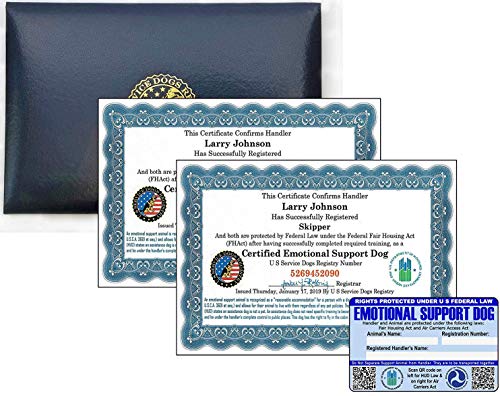
Important: A dog does not need to be "certified" by any organization to be an emotional support animal. The only legally recognized proof of an ESA is a letter from a licensed mental health professional. Any website offering an "ESA certificate," "ESA vest," or "ESA registration" is selling a product with no legal standing.
Who Qualifies for an Emotional Support Animal?
To qualify for an ESA, you must have a mental health condition recognized by the Diagnostic and Statistical Manual of Mental Disorders (DSM-5). Common qualifying conditions include:
- Anxiety disorders, including generalized anxiety disorder and panic disorder
- Major depressive disorder
- Post-traumatic stress disorder (PTSD)
- Obsessive-compulsive disorder
- Bipolar disorder
- Attention-deficit/hyperactivity disorder (ADHD), when it significantly impairs daily functioning
- Certain phobias and other psychiatric conditions
Any dog breed or size can serve as an emotional support animal. There is no breed restriction in the law. However, the animal must be well-behaved and not pose a threat to others or cause substantial property damage — a landlord or airline can deny accommodation if your dog is dangerous or disruptive.
ESA vs. Service Dog vs. Therapy Dog
These three categories are frequently confused, but they have very different legal standing. Understanding the differences protects you from fraud and helps you know exactly what you are entitled to.
| Feature | Emotional Support Animal | Service Dog | Therapy Dog |
|---|---|---|---|
| Training requirement | No specific task training | Individually trained for a specific disability-related task | Tested for temperament and obedience |
| Legal basis | Fair Housing Act; limited ACAA coverage | Americans with Disabilities Act (ADA) | No federal access rights |
| Public access | No | Yes, anywhere the public is allowed | No, only in invited facilities |
| Housing protection | Yes, under FHA | Yes | No |
| Required documentation | ESA letter from licensed mental health professional | No documentation required by law | Certification from a therapy dog organization |
The most important line in this table is the public access distinction. If someone tells you that your ESA can go with you into a supermarket or a restaurant, they are wrong. Only service dogs have that right under the ADA. An ESA that is not also a trained service dog has no public access rights, and misrepresenting your dog as a service animal is illegal in many states.
If your dog is trained to perform a specific task that mitigates your disability — such as interrupting a panic attack, reminding you to take medication, or guiding you to a safe space during a dissociative episode — it may qualify as a psychiatric service dog rather than an ESA. This is a higher legal standard with stronger protections. Our guide on how to get your dog to be a service dog explains the training and documentation requirements in detail.
The ESA Letter: The Only Document That Matters
An ESA letter is a formal document written on the letterhead of a licensed mental health professional. It states that you have a mental health condition that qualifies under the DSM-5 and that the presence of an emotional support animal is necessary for your treatment. It is the single piece of documentation that landlords and airlines can legally require.
What a Valid ESA Letter Must Contain
- The mental health professional's name, title, and license number
- The state in which they are licensed
- The date the letter was written
- A statement that you have a qualifying mental health condition
- A statement that the ESA provides necessary support for that condition
- A recommendation for an emotional support animal as part of your treatment plan
- The professional's signature
A proper ESA letter should not include a diagnosis code or detailed medical history — that would violate your privacy. It should be concise and confirm the therapeutic relationship without oversharing. Landlords are legally permitted to request this letter when you request a reasonable accommodation, but they cannot demand medical records or ask probing questions about your disability.
Warning about online ESA registries: There is no official ESA registry in the United States. Websites that sell "ESA registration," "ESA certificates," or "ESA ID cards" are not recognized by any government agency, landlord, or airline. Purchasing these products does not make your dog an emotional support animal, and presenting them instead of a valid ESA letter can result in denial of accommodation.
Step-by-Step: How to Get Your Dog Certified as an Emotional Support Animal
Follow these steps in order. The process is straightforward when done correctly, and the most important step is the second one — obtaining a legitimate ESA letter.
- Confirm that you have a qualifying mental health condition. You do not need to be in ongoing therapy to qualify, but you do need a genuine condition that a licensed professional can evaluate. If you are unsure whether you qualify, speak with a mental health provider before pursuing an ESA letter.
- Consult a licensed mental health professional. This can be a psychiatrist, psychologist, licensed clinical social worker, licensed professional counselor, or licensed therapist. The professional must be licensed in your state and must conduct a real evaluation — either in person or via telehealth. Many legitimate online services connect you with licensed professionals for this purpose.
- Obtain your ESA letter. After the evaluation, the professional will provide a signed letter confirming that you have a qualifying condition and that an emotional support animal is recommended as part of your treatment. Keep a digital copy and a printed copy.
- Choose your dog. Any breed and any size can be an ESA. If you are still deciding, our dog breed quiz can help you find a breed that fits your lifestyle. Adoption from a shelter is an excellent option — see our guide to animal shelters for where to start.
- Focus on basic obedience and socialization. While ESAs do not require task training, a well-behaved dog is essential. A dog that barks, lunges, or is destructive can be denied accommodation under housing rules. Training resources like our guide on how to stop dog jumping and how to stop dog pulling are a good starting point. Formal socialization during the puppy socialization period pays off for years.
- Request reasonable accommodation when needed. When applying for housing, submit your ESA letter with your accommodation request. Keep copies of all correspondence. You do not need to disclose your diagnosis, only the letter itself.
Keep Your Emotional Support Dog Healthy and Well-Behaved
A healthy, well-trained ESA is a more effective ESA. Explore our recommended gear and care products below.
See Recommended ProductsHousing Rights for ESA Owners
The Fair Housing Act requires landlords, property managers, and homeowner associations to provide reasonable accommodation for emotional support animals. This is one of the strongest and most reliable protections available to ESA owners.
What "Reasonable Accommodation" Means
- Landlords must waive no-pet policies for your emotional support animal
- They cannot charge pet rent or pet deposits for an ESA
- They cannot deny your application solely because you have an ESA
- They may request a valid ESA letter as proof
- You remain responsible for any damage your ESA causes to the property
- The landlord may deny accommodation if the animal poses a direct threat to others or would cause substantial property damage
These protections apply to most housing types, including apartments, condos, and single-family rentals. There are limited exceptions, such as small owner-occupied buildings with four or fewer units where the owner lives on-site, and certain single-family homes rented without a broker. If you are unsure whether your situation is covered, the U.S. Department of Housing and Urban Development (HUD) provides guidance and can investigate complaints.
What landlords cannot do: They cannot ask about the nature or severity of your disability, demand medical records, require a specific type of ESA letter, or charge an extra fee for the animal. If a landlord refuses a reasonable accommodation, you can file a complaint with HUD or your state housing authority.
If you are moving with your ESA, make sure your dog is comfortable with transitions. Our guide on things to help with separation anxiety in dogs is useful if your dog struggles when left alone in a new environment. For trips to a new home, a dog carrier or dog car seat can make travel safer and less stressful.
Travel Rules for Emotional Support Dogs
Airline rules for emotional support animals changed dramatically in 2021. The U.S. Department of Transportation (DOT) updated its definition of service animal to include only trained dogs that perform specific tasks, effectively removing ESAs from the automatic right to fly in the cabin at no charge.
What this means in practice:
- Most airlines now classify ESAs as pets and charge pet fees
- Some airlines no longer allow ESAs in the cabin at all — they must travel as cargo
- Some airlines still permit ESAs in the cabin with advance notice and a valid ESA letter, but policies vary widely
- Psychiatric service dogs — individually trained to perform a disability-related task — retain full ACAA protection and can fly in the cabin at no charge
Always contact your airline directly before booking. Do not rely on outdated information or claims from ESA registry websites. Ask specifically what documentation is required and what the fee structure is. If your dog is small enough to fly as a carry-on pet, a compliant dog carrier that meets your airline's dimensions is essential.
Flying with a psychiatric service dog: If your dog is trained to perform a specific task that mitigates your disability, it may qualify as a psychiatric service dog rather than an ESA. Service dogs are still protected under the ACAA. You will typically need to submit a DOT service animal form in advance, and the dog must be trained to behave properly in public.
ESA Scams and What to Avoid
The emotional support animal industry is unfortunately full of predatory businesses. Knowing how to spot a scam protects your money and your legal standing.
- "Instant" ESA letters without an evaluation. A legitimate ESA letter requires an evaluation by a licensed mental health professional. If a website sells you a letter in five minutes with no questions asked, it is not valid.
- ESA registration databases and ID cards. No government agency recognizes these. They are decorative at best and fraudulent at worst.
- ESA vests and patches sold as "certification." A vest does not make your dog an ESA. In fact, putting a service-dog vest on an untrained ESA can confuse the public and create legal risk.
- Guarantees of housing or travel approval. No third party can guarantee that a landlord or airline will accept your ESA. Only the letter from a licensed professional matters, and even then, accommodation can be denied in narrow circumstances.
- Websites that charge recurring fees. A legitimate ESA letter is a one-time document. If a service charges you a monthly fee to "keep your registration active," it is a scam.
If you need an ESA letter, use a service that connects you with a licensed professional who conducts a real evaluation, or work directly with a therapist or psychiatrist you already see. Legitimate online providers typically conduct a telehealth consultation and issue a letter only after confirming that you qualify.
Costs for a legitimate ESA letter from an online provider are typically in the mid-range tier — affordable compared to ongoing therapy, but not as cheap as the fake certificates sold by scam sites. If you want to understand what a real ESA letter process involves financially, our article on the cost to register a dog as an emotional support animal breaks down the legitimate expenses versus the fake ones.
If you are also considering the difference between an ESA and a fully trained service dog, our guide on getting your dog certified as an emotional support animal covers additional scenarios and legal considerations.
Frequently Asked Questions
The Bottom Line
Getting your dog certified as an emotional support animal is not about buying a certificate or registering in a database. It is about establishing a legitimate therapeutic relationship with a licensed mental health professional and obtaining a valid ESA letter. With that letter, you can request reasonable accommodation in housing and, depending on the airline, potentially travel with your dog. Focus on your mental health, train your dog well, and avoid the scams — that is the path that actually works.
If your dog is struggling with anxiety or behavior issues that affect its ability to be a calm, supportive companion, our guides on calming products for dogs and anxiety wraps for dogs may help. And if you are considering adopting a dog specifically for ESA purposes, our guide to animal shelters is the best place to start.