Pet Crates for Large Dogs: The Complete Buying Guide
Everything you need to choose the right crate for your big dog — sizing, crate types, materials, safety features, and training tips that actually work for large breeds.
Choosing a crate for a large dog is a different game than picking one for a toy breed. Big dogs need more room, stronger materials, and more thoughtful placement. A flimsy crate that a Chihuahua can't damage may be a chew-through toy for a determined Labrador. And a crate that's too small for a Great Dane isn't just uncomfortable — it's a health and safety risk.
Whether you're bringing home a new large-breed puppy or finally upgrading the crate your adult dog has outgrown, this guide breaks down exactly what matters. You'll learn how to measure correctly, which crate types suit different situations, and the features that separate a durable crate from one that fails within weeks. If you're also preparing a puppy space, our puppy guide and puppy preparation checklist pair well with this article.
Why Large Dogs Need a Proper Crate
A crate is one of the most useful tools you can own as a large-dog owner, but only if it's the right crate. Here's what a properly sized, well-built crate actually does for you and your dog:
- Safety during travel and vet visits: A secured crate prevents your dog from distracting the driver or injuring themselves in a sudden stop. For car travel, a sturdy crate or a dog car harness is essential equipment.
- A calm space for recovery: After surgery, injury, or illness, crating limits movement and supports healing. Vets frequently recommend restricted activity, and a crate is the easiest way to enforce it.
- House-training support: Dogs naturally avoid soiling their sleeping area. A correctly sized crate — not too large — helps puppies and adult rescues learn faster. Pair it with a consistent feeding schedule for best results.
- Protection during household chaos: Movers, repair workers, parties, or fireworks are far less stressful when your dog has a safe, familiar den to retreat to.
- Prevention of destructive behavior: A large dog left loose can do serious damage to furniture, walls, and wiring — and can injure themselves chewing on dangerous items. Crating during unsupervised periods protects both the home and the dog.
- Management during introductions: When introducing a new pet or a baby, a crate gives everyone a safe way to be in the same room without direct contact.
Important Perspective: A crate is a management tool, not a lifestyle. Large dogs need substantial daily exercise and mental stimulation outside the crate. If your dog spends most waking hours confined, the crate is masking a bigger problem — revisit their exercise needs and daily routine.
How to Measure & Size Your Crate Correctly
This is where most large-dog owners get it wrong. Sizing isn't about weight — it's about dimensions. Two dogs of the same weight can need very different crate lengths depending on leg length and body shape. A tall, leggy dog needs height; a long-bodied dog needs length.
The Two Measurements That Matter
1. Length (nose to tail base): Measure your dog standing on all fours, from the tip of the nose to the base of the tail (not the tip). Add 2–4 inches. This extra space lets your dog lie down stretched out and turn around comfortably.
2. Height (floor to head/ears): Measure from the floor to the top of your dog's head while they are sitting or standing naturally — whichever is taller. Add 2–4 inches. Your dog must be able to stand upright and sit without their head touching the ceiling.
3. Width: Width matters less than length and height, but your dog should be able to turn around without squeezing. A general rule is at least 1.5 times your dog's shoulder width.
Measure twice: Dogs wiggle. Have someone help hold your dog steady, and measure on a hard floor rather than carpet. If your dog is still growing, measure them again monthly — large-breed puppies can outgrow a crate in a matter of weeks.
Crate Size Reference for Large Dogs
| Crate Size | Typical Dimensions (L × W × H) | Best For |
|---|---|---|
| 36 inch | ~36" × 23" × 25" | Smaller large dogs: Border Collie, Australian Shepherd, mid-size Lab mix |
| 42 inch | ~42" × 28" × 30" | Most large dogs: Labrador Retriever, Golden Retriever, German Shepherd |
| 48 inch | ~48" × 30" × 32" | Extra-large dogs: Rottweiler, Bernese Mountain Dog, large Shepherd mixes |
| 54 inch | ~54" × 35" × 45" | Giant breeds: Great Dane, Mastiff, Irish Wolfhound |
These are general guidelines — always measure your individual dog. A Labrador with an unusually long back may need a 48-inch crate despite weighing the same as a shorter 42-inch dog. If you're crate-training a puppy that will grow into a large adult, buy the adult-size crate now and use a divider panel to shrink the usable space. This saves money and avoids multiple upgrades. For small-breed crate needs, see our guide to puppy crates for small dogs.
Sizing Tip for Puppies: Use the divider panel to give your puppy only enough room to stand, turn around, and lie down. Too much space invites accidents in one corner and sleeping in another — which slows house-training. Move the divider back as your puppy grows.
Crate Types Compared
There's no single "best" crate — the right choice depends on how and where you'll use it. Most large-dog households end up owning more than one type. Here's how the main categories compare.
Wire Crates
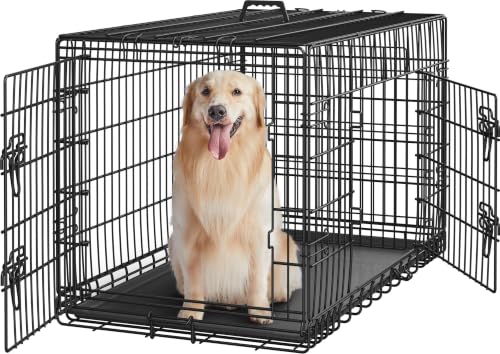
The most popular choice for home use. Excellent ventilation and visibility, folds flat for storage, and often includes a divider panel. Choose heavy-gauge wire (look for thicker bars and reinforced welding) for strong dogs. Best all-around option for most large dogs at home.
Most versatilePlastic (Airline) Crates
Enclosed, den-like design that many dogs find calming. Required for most airline cargo travel. More secure against drafts and less likely to be chewed than wire. Downside: less visibility, harder to clean, and strong dogs can crack thinner plastic shells. Choose heavy-duty models for large breeds.
Best for travelHeavy-Duty / Escape-Proof Crates
Built with reinforced steel bars, stronger latches, and welded frames for dogs who destroy standard crates. Essential for escape artists and severe separation anxiety cases. Heavier and bulkier, but the peace of mind is worth it for the right dog. Consider pairing with behavior modification techniques rather than relying on the crate alone.
Maximum durabilityFurniture-Style Crates
Wood or wood-look crates that double as end tables or sideboards. Blend into living spaces and reduce the "cage" look. Quality varies widely — check that the frame is solid and the door latch is secure. Best for calm dogs who don't chew; not recommended for puppies or heavy chewers.
Best for aestheticsSoft-Sided Crates
Lightweight fabric crates great for camping, hotel stays, and calm dogs. Easy to carry and set up. Not appropriate for chewers or dogs who push against the sides — most large dogs can break out of fabric crates. Treat as a travel convenience, not a primary crate.
Travel convenienceExercise Pens & Gates
Not crates, but useful companions. A tall exercise pen gives a large puppy more room than a crate while still limiting access. Combine with dog gates to section off a safe room. Great for puppies not yet ready for full crate confinement at night.
Puppy companionQuick Comparison
| Crate Type | Ventilation | Durability | Portability | Best Use Case |
|---|---|---|---|---|
| Wire | Excellent | Good–High | Good (folds flat) | Home use, training |
| Plastic | Moderate | Moderate | Good | Airline travel, den-like feel |
| Heavy-duty | Excellent | Very High | Low (heavy) | Escape artists, strong chewers |
| Furniture | Moderate | Moderate–Good | Low | Calm dogs, visible living areas |
| Soft-sided | Good | Low | Excellent | Travel, calm dogs only |
Key Features to Look For
Two crates can look identical online and perform very differently in your living room. These are the features that separate a crate that lasts years from one you regret within a month.
Non-Negotiable Features
- Secure, dog-proof latches: Large dogs are smart and strong. Look for dual-point or sliding bolt latches — not simple friction latches that a paw or nose can nudge open. Escape-prone dogs often defeat single-latch crates within days.
- Heavy-gauge construction: For wire crates, thicker bars and reinforced welding at stress points are essential. Thin-gauge wire bends under a large dog's weight and creates sharp edges that can injure paws and muzzles.
- Removable floor tray: Accidents happen. A slide-out tray makes cleaning dramatically easier and protects your floors. Plastic trays are lighter; metal pans are more chew-resistant.
- Divider panel (for puppies): If you're raising a large-breed puppy, a divider lets you use one adult-size crate from day one. Not all crates include one — check before buying.
- Rounded corners and edges: Sharp wire ends and exposed welds can cut noses and paws. Quality crates finish edges smoothly and tuck connection points safely.
Strongly Recommended Features
- Two doors (front and side): A side door gives you flexibility in tight rooms and makes it easier to feed or reach your dog without moving the crate.
- Fold-flat design: Essential if you need to store the crate or transport it occasionally. Most wire crates fold, but check the mechanism — some are much easier to operate than others.
- Carry handles: Large crates aren't light. Handles make moving them between rooms and vehicles far easier.
- Floor protection feet: Rubber or plastic feet prevent scratching on hardwood and reduce noise when your dog shifts around.
- Compatible accessories: Look for crates that support crate covers, mats, and water bowls designed for the same dimensions. A comfortable dog mat or crate pad makes a real difference in how willingly your dog uses the crate.
- Replacement parts availability: Latches, trays, and panels do break. Brands that sell replacement parts save you from buying an entirely new crate.
Chewers & Escape Artists: If your dog has already bent wire or broken out of a crate, standard models won't hold. Look for purpose-built escape-proof crates with reinforced steel frames, and pair the crate with a professional behavior assessment. See when to see a behaviorist — crating alone won't solve underlying anxiety.
Materials & Durability
Material choice affects durability, weight, ease of cleaning, and how your dog feels about the crate. Here's how the common materials perform for large dogs:
Wire & Steel
The standard for large-dog home crates. Steel wire offers excellent airflow and visibility, which reduces anxiety for many dogs. Quality is measured in gauge — lower gauge numbers mean thicker wire. Heavy-duty crates use reinforced steel tubing and welded frames rather than bent wire alone.
Wire crates are easier to clean than plastic because everything is visible and accessible. They also fold flat, which plastic crates generally don't. The tradeoff: wire offers little insulation in cold rooms and no visual "den" effect for dogs who prefer enclosure.
Plastic & Composites
Plastic crates are molded as a top and bottom shell with a metal door. They're warmer and more enclosed — many dogs settle faster in them. They meet airline travel requirements when sized and labeled correctly, which makes them the practical choice for frequent flyers.
For large dogs, avoid thin-shell economy plastic crates. Look for reinforced corners, thicker shells, and metal hardware rather than plastic clips. A determined large dog can crack thinner plastic with paws or teeth. Heavy-duty plastic kennels designed for working dogs are a better match.
Material Pros & Cons at a Glance
| Material | Pros | Cons |
|---|---|---|
| Wire / steel | Great airflow and visibility, folds flat, easy to clean, divider-friendly | Heavier, no insulation, less den-like feel |
| Plastic | Enclosed and calming, warm, airline-compatible | Cracks under stress, harder to clean, limited visibility |
| Wood / furniture | Blends into home decor, sturdy frame options | Heavy, poor ventilation if enclosed, chew risk for puppies |
| Fabric / soft-sided | Lightweight, portable, quick setup | Not secure for strong dogs, easy to tear |
Crate Training Large Dogs
Crate training works the same way for a Mastiff as for a Maltese — the principles don't change with size. What changes is the stakes: a large dog who panics in a crate can injure themselves or damage the crate, so patience matters more than speed.
Step-by-Step Crate Training
- Set up the crate in a family area: Dogs are social animals. A crate isolated in a garage or basement feels like punishment. Place it where the family spends time, and remove the door or tie it open at first.
- Make the crate rewarding: Toss treats inside, feed meals next to the crate, then inside with the door open. Let your dog explore at their own pace — never push or shove them in. For puppies, see how to stop your puppy from crying in the crate.
- Close the door for seconds, then minutes: Start with the door closed only while your dog eats, then open it immediately. Gradually extend the time while you stay nearby. Build duration slowly over days, not minutes.
- Add distance, then duration: Once your dog is relaxed with the door closed and you nearby, step away for short periods. Return before your dog becomes anxious. Never let them "cry it out" to the point of panic — that teaches the crate is frightening.
- Practice departures separately: Crate training and alone-training are different skills. Practice leaving the room, then the house, for short periods, returning calmly. Do not make departures emotional.
- Use the crate for good things only: Feed in the crate, give long-lasting chews there, and reward your dog for entering voluntarily. Never use the crate as punishment or timeout for misbehavior. A durable chew toy or a stuffed puzzle toy works well as a crate-time treat.
Adopted Adults: Older dogs may have negative crate associations from previous homes. Go slower, use higher-value treats, and consider a crate cover to create a den-like space. Pair the crate with anxiety wraps or calming products if your dog shows genuine distress — and consult a professional if the panic persists.
How Long Can a Large Dog Stay in a Crate?
Adult dogs should not be crated for more than 4–6 hours during the day. Puppies need much shorter intervals based on their age: roughly one hour per month of age, plus one, up to a maximum that matches their bladder control. Overnight crating is normal for many adult dogs, but during the day, long confinement is not a substitute for a dog walker, dog daycare, or a secure exercise pen. A large dog with pent-up energy will be harder to crate-train, not easier. Review your dog's mental stimulation plan and daily exercise first.
Safety Rules & Common Mistakes
A crate should be the safest place in your home for your dog. These rules keep it that way.
- Remove collars and tags inside the crate: A collar can catch on wire bars and strangle a dog. This is one of the most common and preventable crate injuries. Use a breakaway collar if your dog must wear identification indoors.
- Never use a crate that's too small: A dog who can't stand, turn around, and lie flat is at risk of muscle atrophy, pressure sores, and stress. Re-measure as your dog grows.
- Don't crate a dog in heat or after surgery without vet guidance: Follow your veterinarian's specific instructions — confinement needs vary by procedure.
- Secure the crate during car travel: An unsecured crate becomes a projectile in a crash. For car safety, use a crash-tested crate or a properly fitted dog car seat or dog seat belt.
- Avoid overheating: Wire crates are open and ventilated, but a crate in direct sun or near a heater can still overheat a dog. Provide fresh water and airflow. A crate-compatible water bottle prevents spills and keeps hydration available.
- Check for sharp edges and loose hardware: Inspect the crate monthly. Tighten bolts, check latches, and look for bent bars or exposed wire ends. Replace damaged parts immediately.
- Never crate a dog with a choke-risk toy: Any toy small enough to swallow or with strings and straps should be removed when your dog is unsupervised.
- Don't rely on the crate for behavior problems: Excessive barking, destruction, or house-soiling often signal unmet needs — exercise, training, or medical issues. A crate manages the symptom; it doesn't fix the cause.
Placement Matters: Put the crate in a climate-controlled area away from direct sunlight, radiators, and exterior doors. Avoid placing it against a wall that vibrates or near loud appliances. Dogs settle best when the crate has one solid side (a wall or a crate cover) so they can rest without feeling exposed from all directions.
Frequently Asked Questions
Ready to Choose?
Match the crate to your dog's measured dimensions, not their breed label. Prioritize secure latches, heavy-gauge construction, and a removable tray. If you're raising a large-breed puppy, buy the adult-size crate now with a divider. And remember: the crate is a tool that supports a good routine — exercise, training, and companionship do the rest. Browse our recommended large-dog crates below to compare current options.