Most Effective Flea and Tick Prevention for Dogs
Fleas and ticks are more than a nuisance—they transmit serious diseases and cause chronic discomfort. This guide cuts through the marketing to help you choose a prevention strategy that actually works for your dog’s lifestyle, health, and your household.
Why Effective Prevention Matters
Fleas and ticks are not just seasonal annoyances. Fleas can trigger severe allergic dermatitis, cause anemia in small dogs or puppies, and transmit tapeworms [citation:2]. Ticks are vectors for Lyme disease, anaplasmosis, ehrlichiosis, and Rocky Mountain spotted fever—diseases that can cause lasting joint damage, organ failure, or neurological problems [citation:2][citation:15].
The challenge is that both parasites are resilient. Fleas can survive indoors year-round, hiding in carpet fibers and bedding even during winter. Ticks remain active at temperatures as low as 40°F, which means a mild winter day is enough to expose your dog [citation:15]. That is why veterinary parasitologists consistently recommend year-round prevention rather than a seasonal approach [citation:1][citation:15].
If you are also managing heartworm risk, you may benefit from an all-in-one monthly preventive that simplifies your routine. For dogs with sensitive skin, explore gentler prevention options before committing to a product.
Key takeaway: The "most effective" product is the one that matches your dog’s risk level and that you can administer consistently. A missed dose is a bigger failure point than the difference between two quality products.
Comparing the Main Prevention Types
Flea and tick prevention falls into three broad categories: oral chews, topical spot-ons, and collars. Each has distinct advantages and limitations. The table below summarizes how they compare on the factors that matter most.
| Feature | Oral Chews | Topical Spot-Ons | Collars |
|---|---|---|---|
| Speed of kill | Fast (often within 12–24 hours for ticks) | Moderate; some kill on contact | Continuous, slow-release |
| Water resistance | Unaffected by bathing or swimming | Varies; some require 48-hour dry time | Water-resistant but prolonged submersion reduces lifespan |
| Prevents tick attachment | No (kills after bite) | Some repel (e.g., permethrin-based) | Yes (e.g., Seresto) |
| Residue on coat | None | Yes; caution with children/cats | Minimal |
| Dosing frequency | Monthly to every 12 weeks | Monthly | Up to 8 months |
| Prescription needed | Usually yes | Often OTC available | No (Seresto) |
Oral Prescription Chews: The Gold Standard for High-Risk Dogs
For dogs with significant outdoor exposure—hiking companions, farm dogs, or dogs living in Lyme-endemic regions—prescription oral isoxazolines are widely considered the most reliable option. Products like Bravecto (fluralaner), NexGard (afoxolaner), Simparica (sarolaner), and Credelio (lotilaner) circulate systemically and kill parasites when they bite [citation:1][citation:15].
The critical advantage is speed. Ticks transmit Lyme disease only after 24–48 hours of attachment. Oral products typically kill ticks well within that window, dramatically reducing transmission risk [citation:11]. NexGard is the only flea and tick product with an FDA-approved claim to help prevent Lyme infection by killing black-legged ticks [citation:11].
Bravecto (Fluralaner)
Offers 12 weeks of protection per chew, reducing the risk of forgotten doses. A single injectable version providing 12 months of coverage is available in some regions. Effective against fleas and multiple tick species.
Premium tier · Longest intervalNexGard (Afoxolaner)
Monthly chew with rapid tick kill and the only FDA-approved claim for Lyme disease prevention. Covers six tick species. A strong choice for dogs in high-Lyme areas.
Mid-range tier · Lyme-focusedSimparica Trio
Combines flea, tick, and heartworm prevention with intestinal worm coverage. Convenient for owners who want a single monthly chew for comprehensive parasite control.
Premium tier · All-in-oneCredelio Quattro
Broad-spectrum monthly chew covering fleas, ticks, heartworms, roundworms, hookworms, and tapeworms. A good fit for dogs at risk of multiple parasite types.
Premium tier · Broad coverageSafety note: Isoxazoline products carry an FDA warning about rare neurological reactions, including tremors and seizures. Dogs with a history of seizure disorders should be evaluated carefully by a veterinarian before starting these medications [citation:3][citation:4].
If you prefer to explore non-prescription oral options, be aware that OTC chews are generally less potent and have narrower coverage than prescription isoxazolines. For a broader comparison, see our guide to the most effective flea and tick medicines.
Topical Spot-On Treatments: Contact Protection and Repellency
Topical treatments are applied between the shoulder blades and distribute across the skin’s surface. They are a strong choice for dogs that resist oral medication or for owners who want a repellent effect that stops ticks before they attach.
Fipronil-based products (like Frontline Plus) kill fleas and ticks after contact but do not repel ticks; a tick may remain attached for 24 hours before dying [citation:15]. Permethrin-based topicals (like K9 Advantix II) do repel and kill ticks, mosquitoes, and biting flies on contact—but permethrin is highly toxic to cats and must never be used in households with cats [citation:6][citation:15].
For dogs with thick double coats, topical application can be challenging because the liquid must reach the skin rather than sitting on fur. Oral medications often provide more consistent coverage for these breeds [citation:7]. If your dog has a flea allergy, a repellent topical may still be valuable because it prevents the bite that triggers the allergic response.
Explore topical flea treatment options and OTC flea and tick medicines for more detailed comparisons.
Long-Acting Collars: Set-and-Forget Convenience
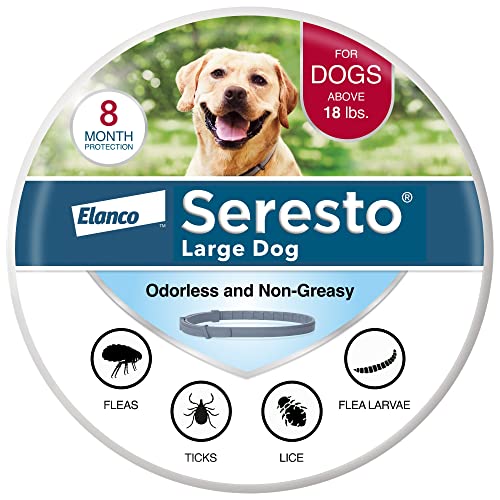
The Seresto collar (imidacloprid + flumethrin) provides up to 8 months of continuous flea and tick protection from a single application. It repels and kills parasites, and it prevents tick attachment—a meaningful advantage in high-risk areas [citation:15]. It is available without a prescription and is approved for puppies 7 weeks and older [citation:14].
Collars are ideal for owners who worry about missed monthly doses. However, they must fit snugly enough to maintain skin contact (you should be able to slide two fingers under the collar), and they may need replacement sooner if the dog swims frequently [citation:15]. Collars do not treat an active household infestation; they protect the wearer only.
Environmental Control & Yard Safety
Treating your dog is only half the battle. Fleas spend most of their life cycle—eggs, larvae, and pupae—in the environment, not on the host. If your dog has brought fleas indoors, you must address the home to break the cycle [citation:2].
- Vacuum frequently: Focus on carpets, rugs, furniture, and areas where your dog rests. Vacuuming removes eggs and larvae and stimulates pupae to emerge, where they can be killed by preventives.
- Wash bedding in hot water: Weekly washing of dog beds and blankets kills immature flea stages.
- Manage your yard: Keep grass short, remove leaf piles and debris, and trim brush where ticks quest. Pay attention to shaded areas under decks and along fence lines [citation:8].
- Discourage wildlife: Rodents, deer, and raccoons can carry ticks and fleas into your yard. Secure trash and remove attractants.
For safe options to treat your outdoor space, see natural yard repellents safe for dogs.
Common Prevention Mistakes
- Stopping treatment in winter. Fleas thrive indoors and ticks remain active in mild temperatures. Year-round protection prevents the spring surge before it starts [citation:15].
- Using dog products on cats. Permethrin, common in dog topicals, is lethal to cats. Never apply a dog product to a cat, and keep treated dogs separated from cats until the product dries [citation:6][citation:16].
- Bathing too soon after topical application. Most topicals need 48 hours to distribute through the skin’s oils. Bathing sooner can wash away the medication before it works [citation:15].
- Relying on flea shampoos as prevention. Shampoos kill fleas on contact but have no residual activity—often less than 24 hours. They are useful during an active infestation but do not replace a preventive [citation:3].
- Missing doses. A survey found that 46% of dog owners had forgotten a flea and tick treatment in the past year [citation:1]. Longer-acting options or calendar reminders can close this gap.
If you are struggling with an active infestation, our guide on the best way to get rid of fleas on a dog walks through the elimination process step by step.
Frequently Asked Questions
The Bottom Line
There is no single "best" product for every dog—but there is a best product for your dog. High-exposure dogs benefit most from prescription oral isoxazolines with fast kill times. Dogs in cat households or with sensitive skin may do better with oral medications that leave no residue. Owners who struggle with monthly routines should consider longer-acting collars or extended-interval chews. Whichever route you choose, pair it with year-round consistency, regular tick checks, and environmental management. Your veterinarian is your best resource for tailoring a plan to your dog’s specific health profile and local parasite risks.