Dog Kennel for a Large Dog: The Complete Guide
Everything you need to choose, set up, and use a kennel for a large breed — sizing, materials, safety, training, and the mistakes that turn a safe space into a stressful one.
A kennel is one of the most misunderstood pieces of dog equipment. Used well, it becomes a safe den where a large dog can rest, recover, and stay out of trouble. Used poorly, it becomes a source of chronic stress that damages behavior and trust. The difference almost always comes down to three things: correct sizing, the right construction for your dog's strength, and patient training.
Large dogs present specific challenges that small-dog owners never face. A 90-pound dog can bend thin wire, pop weak latches, and tip a lightweight crate. A bored large breed can chew through wood panels and dig under a kennel floor. At the same time, a large dog needs more room to stand, turn, and stretch out than most off-the-shelf crates provide. This guide walks you through every decision so you can buy once and buy right.
Quick Orientation: If you already know you want a crate-style kennel, focus on the sizing and materials sections. If you are planning an outdoor run, read the outdoor kennel and climate sections carefully before you buy anything. If your dog has never been kenneled, start with the training section — the best kennel in the world fails without it.
Why Large Dogs Need the Right Kennel
Kennels serve several legitimate purposes for large-dog owners. They provide a safe place during travel, a managed space during recovery from surgery or injury, a tool for house training, and a way to keep a destructive chewer out of harm when you cannot supervise. Large breeds are also more prone to certain injuries — bloat, joint strain, and post-surgical complications — which makes a calm, secure resting space genuinely valuable.
The problem is that large dogs are often given kennels that are too small. Owners buy for the puppy they brought home, then never upgrade as the dog grows. A dog who cannot stand upright or turn around comfortably will resist the kennel, and that resistance is often misread as stubbornness rather than discomfort.
What a Kennel Is Not
A kennel is not a substitute for exercise, training, or companionship. It is not a punishment zone. And it is not a permanent housing solution for an outdoor dog. If your plan involves leaving a large dog in a kennel for most of the day, the kennel is not the real problem — your schedule and support system are. Consider dog sitters, training classes, and mental stimulation before relying on confinement.
Rule of thumb: A kennel should be a place your dog chooses to enter, not a place they are forced into. If your dog runs away when the kennel door opens, something in your setup or training needs fixing.
How to Size a Kennel for a Large Dog
Sizing is the single most important decision. An undersized kennel is uncomfortable and unsafe; an oversized kennel defeats the purpose for puppies and dogs who are not yet house trained. Here is the measurement method professionals use.
- Measure length: Measure your dog from the tip of the nose to the base of the tail while standing. Add 4-6 inches. This is the minimum interior length.
- Measure height: Measure from the floor to the top of the head or the tips of the ears, whichever is higher. Add 2-4 inches. Your dog must be able to stand without crouching.
- Measure width: Measure the widest point of your dog's body, usually the shoulders or chest. Add 2-3 inches. Your dog must be able to turn around without scraping the sides.
For most large breeds — Labrador Retrievers, German Shepherds, Golden Retrievers, Boxers, and similar — a kennel around 36 to 42 inches long works. Giant breeds such as Great Danes, Mastiffs, and Irish Wolfhounds often need 48 inches or more, or a custom-built run. Always check the manufacturer's weight and breed guidance, but treat it as a starting point rather than a final answer.
| Dog Size | Typical Weight Range | Minimum Kennel Length | Best Kennel Style |
|---|---|---|---|
| Medium-large | 50–70 lbs | 36 inches | Standard wire or plastic crate |
| Large | 70–90 lbs | 42 inches | Reinforced wire or heavy plastic crate |
| Extra-large | 90–110 lbs | 48 inches | Heavy-duty crate or indoor run |
| Giant | 110+ lbs | 54 inches or custom | Custom indoor run or kennel panel system |
If you are buying for a puppy, the common advice is to buy the adult-size kennel and block off the extra space with a divider panel. This works well, but only if you actually use the divider. Without it, a puppy will use one end as a bathroom and the other as a bed, which slows house training. Pair the kennel with a consistent schedule and plenty of potty breaks.
Types of Kennels for Large Breeds
There is no single best kennel. The right choice depends on whether the kennel is for indoor or outdoor use, how strong your dog is, how often it will be moved, and how much space you have. These are the main categories you will encounter.
Wire Crates
Wire crates are the most common indoor option. They offer excellent ventilation, fold flat for travel, and let your dog see the room around them. For large breeds, look for thicker gauge wire, reinforced corners, and at least two latches on the door. Cheap wire crates bend easily and can be defeated by a determined dog. Wire crates work well inside the home and pair nicely with a dog mat or crate pad for comfort.
Plastic Travel Crates
Plastic crates, often called airline crates, are enclosed and draft-resistant, which makes them a good choice for travel and for dogs who prefer a den-like feel. They are generally sturdy but can become hot in direct sun. For large dogs, check the weight rating carefully and confirm the door latch is metal rather than plastic. These are a strong option if you frequently transport your dog by car using a dog carrier or need a crate that fits a dog seat belt setup.
Soft-Sided Crates
Soft-sided crates are lightweight and easy to store, but they are not appropriate for most large dogs. A large breed with any shredding tendency will destroy a fabric crate quickly. Reserve soft crates for calm, well-trained adults in supervised settings, or for small dogs.
Heavy-Duty and Escape-Proof Crates
For dogs who have escaped standard crates, heavy-duty crates use welded steel bars, reinforced frames, and barrel-style latches. They are expensive and heavy, but they are the only safe option for serious escape artists. If your dog has injured themselves escaping a crate, this is the category to buy from — not a cheaper crate with extra clips.
Outdoor Kennel Runs and Panels
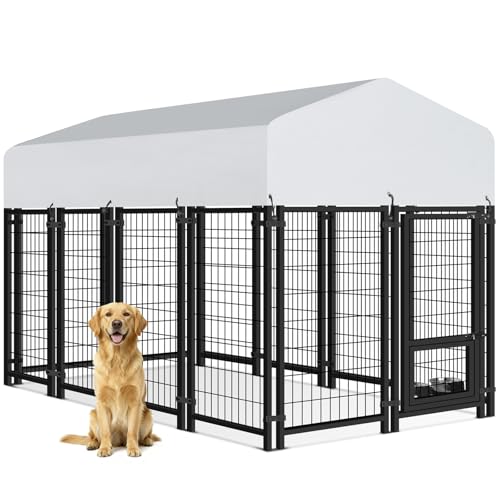
Outdoor kennels are built from modular panels, usually galvanized steel or welded wire, and can be configured as a run, a covered kennel, or a full enclosure with a roof. They are the best option for supervised outdoor time, temporary containment, or a safe potty area. A well-built outdoor kennel should include shade, a raised sleeping platform, and a solid roof. For related outdoor containment, compare with a dog fence and dog gates for indoor separation.
Materials and Durability
Large dogs test materials in ways small dogs never do. A 20-pound dog scratching at a crate door is annoying; a 90-pound dog doing the same can bend bars and break latches. Material quality is not a luxury for large breeds — it is a safety requirement.
- Galvanized steel: The most durable and rust-resistant option for outdoor kennels. Welded galvanized panels resist chewing better than wire and hold up to weather. The best choice for permanent outdoor setups.
- Powder-coated steel: Common in indoor crates. The coating resists rust and is easy to wipe clean, but it can chip. Inspect regularly for exposed metal edges.
- Aluminum: Lightweight and rust-proof, making it a good choice for travel crates. It is less rigid than steel, so large dogs may flex lighter aluminum frames.
- High-density plastic: Used in airline-style crates. Durable, easy to clean, and impact-resistant, but not chew-proof. Not suitable for dogs who chew aggressively.
- Wood: Attractive for indoor furniture-style kennels and outdoor dog houses, but it requires maintenance and is vulnerable to chewing and moisture. Use only with dogs who do not chew and only with treated, non-toxic finishes.
- Welded wire mesh: Affordable and ventilated, but thin gauge wire is easily bent by large dogs. Choose at least 12-gauge wire for large breeds, and inspect welds regularly.
Whichever material you choose, check three things before buying: latch strength, floor construction, and edge finishing. Latches should be metal, ideally with a secondary locking mechanism. Floors should be solid or have a removable tray — wire floors can cause paw injuries. Edges should be smooth with no sharp points that could cut a paw or nose.
Indoor vs Outdoor Kennels
This is the decision that causes the most disagreement among dog owners, so it is worth being clear about what each option is actually good for.
Indoor Kennels
Indoor kennels are the right choice for most large dogs. They keep the dog close to the family, protect them from weather and theft, and make house training and behavior management far easier. Indoor kennels also let you monitor your dog for signs of illness or distress. If your dog spends most of their day indoors with you, an indoor crate or a furniture-style kennel is the practical choice. Pair it with a comfortable dog bed or crate pad.
Outdoor Kennels
Outdoor kennels are appropriate for supervised daytime use, temporary containment during yard work, and as a safe potty or rest area. They are not appropriate as full-time housing. Dogs are social animals, and isolation in an outdoor kennel causes anxiety, barking, and behavioral decline. If your dog must spend time outdoors, the kennel should have shade at all times, a raised dry platform, constant access to fresh water, and a solid roof. In extreme heat or cold, bring the dog inside.
Climate Note: Brachycephalic breeds — Bulldogs, Boxers, Pugs, and similar flat-faced dogs — overheat far faster than other breeds and should never be left in an outdoor kennel in warm weather. Large double-coated breeds such as Huskies and Malamutes struggle in heat as well. When in doubt, indoor wins.
Setting Up the Kennel Correctly
A correctly set up kennel is comfortable, secure, and boring in the best way. Boredom prevents chewing; comfort prevents whining; security prevents escapes. Here is how to get all three.
- Choose the right location: Place an indoor kennel in a room where the family spends time, not in an isolated basement or garage. Dogs want to be near their people. Avoid direct sun, heating vents, and drafty doors.
- Add a comfortable base: Use a washable crate pad or orthopedic dog mat. For senior dogs or large breeds prone to joint issues, consider a joint supplement and an orthopedic bed. Avoid loose blankets that puppies can chew and swallow.
- Include one safe toy: A durable chew toy or puzzle toy gives your dog something appropriate to do. Avoid ropes and plush toys that can be shredded and ingested.
- Keep water available: For short periods, a secured bowl is fine. For longer periods in warm weather, use a dog water bottle that attaches to the crate to prevent spills.
- Secure the kennel: For outdoor kennels, anchor panels to the ground and confirm the roof is attached. For indoor crates, place them against a wall or in a corner to reduce movement.
- Remove the collar: Never leave a collar, tags, or a dog tag on a kenneled dog. Tags can catch on wire and cause strangulation. Use a breakaway collar if you must leave one on.
Kennel Training for Large Dogs
Kennel training is not complicated, but it requires patience and consistency. Large dogs often learn faster than expected because they are eager to please — but they also pick up on owner anxiety quickly. If you are stressed about the process, your dog will be too.
A Step-by-Step Approach
- Make the kennel neutral or positive: Leave the door open and toss high-value treats inside. Never force your dog in. Let them investigate on their own.
- Feed meals near the kennel: Place the food bowl just outside the door, then just inside, then at the back. This builds a positive association without pressure.
- Add a cue: Say "kennel" or "crate" just before your dog enters, then reward. Keep the word consistent across everyone in the household.
- Close the door briefly: Start with seconds, then minutes. Stay in the room at first, then step out for short periods. Return before your dog becomes distressed.
- Build duration gradually: Increase time in small increments. If your dog whines, wait for a pause in the whining before opening the door — never open it while they are barking.
- Keep arrivals and departures calm: Do not make a big emotional scene when you leave or return. Quiet, matter-of-fact comings and goings reduce separation anxiety.
If your dog shows severe distress — drooling, frantic digging, self-injury, or nonstop barking — stop and consult a professional. For related issues, see our guides on separation anxiety, calming products, anxiety wraps, and pheromone diffusers. In serious cases, a qualified behaviorist is the right next step.
Training tip: Short, frequent sessions beat long ones. Five minutes, three times a day, will teach a large dog to love the kennel faster than one long session that ends in frustration.
Safety, Comfort, and Climate
Once your dog is comfortable in the kennel, your job shifts from training to maintenance. These are the safety checks that matter most for large breeds.
- Inspect hardware monthly: Check latches, hinges, welds, and bolts. Large dogs can work a loose latch open over time. Replace worn parts before they fail.
- Watch for wear on the floor: Wire floors cause paw injuries, and plastic trays crack. Use a solid floor or a flat tray with a soft mat on top. For paw protection during outdoor activity, see dog paw protection and dog shoes.
- Manage temperature: Never leave a dog in a kennel in direct sun. Provide shade and airflow outdoors, and keep indoor kennels away from heat sources. In winter, insulate outdoor kennels and use a raised platform to keep your dog off cold ground.
- Keep the kennel clean: Wipe down surfaces weekly and wash bedding regularly. Use pet-safe cleaners. For accidents, a dedicated dog stain remover works better than household products.
- Limit confinement time: Adult large dogs should not be crated more than 4-6 hours at a stretch during the day. Puppies need far shorter intervals. Arrange midday breaks if you work long hours.
- Provide exercise outside the kennel: A kenneled dog still needs daily walks, play, and mental work. If your dog is destructive in the kennel, the fix is usually more exercise, not a stronger kennel. See our guide on mental stimulation for ideas.
Emergency Readiness: Keep a dog first aid kit accessible near your kennel setup, and know the signs that require immediate veterinary care — labored breathing, collapse, repeated vomiting, or sudden lameness. Kennel-related injuries are rare when equipment is well maintained, but they are serious when they happen.
Common Kennel Mistakes to Avoid
Most kennel problems trace back to one of these errors. Fixing them is usually simpler than buying new equipment.
- Buying too small: The most common mistake. A dog who cannot stand or turn will resist the kennel and may injure themselves trying to escape. Measure properly before you buy.
- Using the kennel as punishment: If the kennel becomes a "time out" zone, your dog will avoid it. Use a separate, neutral space for time-outs, and keep the kennel positive.
- Leaving the collar on: Tags and collars catch on wire and cause strangulation. Remove them before kenneling, every time.
- Skipping exercise before confinement: A pent-up large dog will bark, dig, and chew. A brisk walk or play session before kennel time makes a dramatic difference.
- Over-confinement: Kennels are for hours, not days. If your dog is in a kennel for most of their waking life, the problem is your schedule, not your dog.
- Ignoring escape attempts: A dog who has escaped once will try again and may injure themselves. Upgrade to a heavy-duty crate or consult a trainer rather than adding clips to a failing crate.
- Putting the kennel in isolation: Dogs are social. A kennel in a garage or basement far from the family creates anxiety and barking. Keep it where the family spends time.
- Neglecting the outdoor kennel's climate: Heat stroke and hypothermia are preventable. Provide shade, ventilation, insulation, and fresh water, and bring your dog inside in extreme weather.
Frequently Asked Questions
The Bottom Line
Choosing a dog kennel for a large dog comes down to correct sizing, durable materials, and patient training. Measure your dog before you buy, choose a kennel built for their strength, set it up as a comfortable den rather than a punishment zone, and put in the training time. A large dog who loves their kennel is easier to travel with, easier to manage after surgery, and safer when you cannot supervise. If you are still deciding on the rest of your setup, start with our dog supplies checklist and dog houses guide for outdoor options.